RecoverySoftware’s Blog – Page 2

Discover effective methods and step-by-step guides to recover data from your devices. Stay ahead of the game with our advice on retrieval data or storage security.

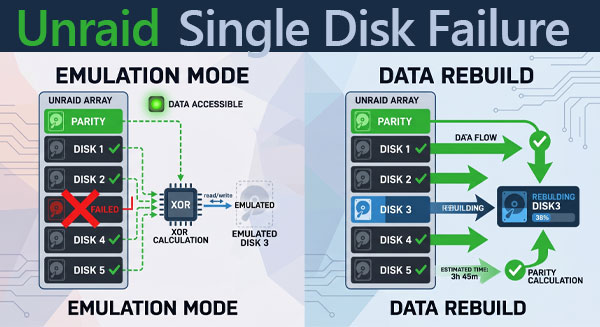
A single disk failure in an Unraid array is a predictable, manageable event — provided you respond to it correctly. The system keeps running, your data remains accessible, and there is a defined path to full recovery. None of this is accidental. It follows directly from how Unraid structures its arrays.

This article covers the mechanics behind that protection, the correct procedure for replacing a failed drive, and what to do when the standard path doesn't work and data needs to be extracted from the outside.
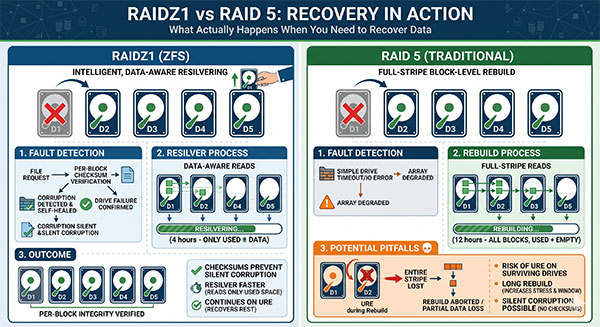
When someone contacts a data recovery specialist about a failed array, the answer to "which RAID level is it?" shapes everything that follows. RAIDZ1 and RAID 5 share the same fundamental idea — distribute parity across disks so any single drive can be lost without data loss — but they behave quite differently under stress. Those differences become very concrete once you're staring at a degraded array. This article focuses on what the architectural differences mean for failure probability, recovery difficulty, and which tools actually work in each case.

We've all been there. You're cleaning up your computer, holding down Shift and Delete to remove files quickly, and suddenly realize you've just permanently deleted something important. That sinking feeling in your stomach is all too familiar, but here's the good news: shift deleted files recovery is possible, and those files might not be gone forever.

Have you ever felt that sinking feeling in your stomach when you realize you've just emptied the Trash on your Mac — and that important presentation you've been working on for weeks was in there? You're not alone. This scenario plays out countless times every day for Mac users around the world. The good news? In most cases, your files aren't actually gone. They're just hidden, waiting to be recovered.

How to Recover Data from a Hikvision RAID — surveillance systems that use disk arrays to improve reliability and performance. The process can be challenging because, in addition to the proprietary Hikvision file system, it also involves the RAID structure itself. Standard data recovery software is not capable of handling this type of setup.

How to recover data from a Hikvision DVR? This is not straightforward even if the hard drive is intact and the files have not been deleted. The DVR uses a proprietary Hikvision file system that is not supported by any desktop operating system.

The task can be solved using another Hikvision DVR. Alternatively, use a computer and data recovery software that supports the Hikvision file system.