RecoverySoftware’s Blog

Discover effective methods and step-by-step guides to recover data from your devices. Stay ahead of the game with our advice on retrieval data or storage security.

Two drives have failed in your Synology SHR-1 array. DSM reports the storage pool as Crashed and states that data cannot be recovered. SHR-1 data recovery after a double drive failure is the subject of this article — and the situation is more nuanced than DSM's message suggests. Whether your data is recoverable depends not on the count of failed drives alone, but on how they failed and what state the surviving drives are in.

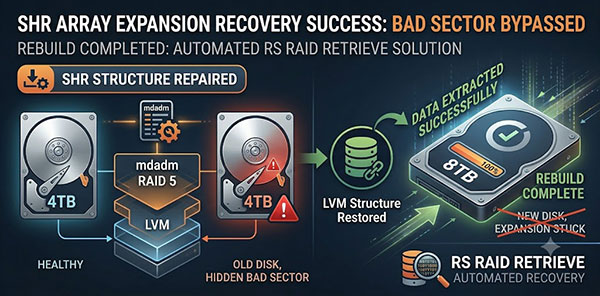
You replaced a 4 TB drive in your Synology SHR array with an 8 TB drive. The rebuild started, ran for a while — and then stopped. DSM shows Degraded, Crashed, or the progress bar has not moved in hours. The NAS may have become unresponsive entirely. This article covers data recovery after an SHR rebuild crash: what actually happened inside the array, how to read the current state without making it worse, and how to get your files back.

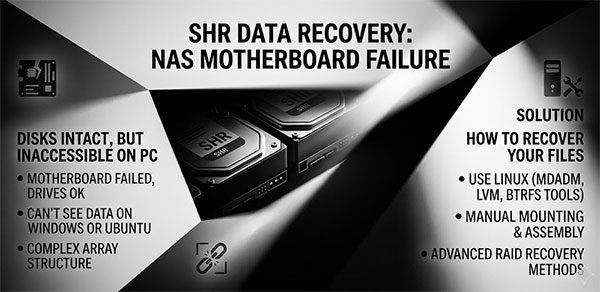
The NAS is dead. The drives are intact. You connect them to a Windows or Linux machine and either see a "You need to format this disk" prompt, or the drives are not visible at all. This is not data loss — it is an access problem. Unlike scenarios where the drives themselves fail, a dead Synology motherboard leaves the SHR volume data physically untouched. What you need to recover is not the data itself, but access to the multi-layered structure Synology uses to store it.

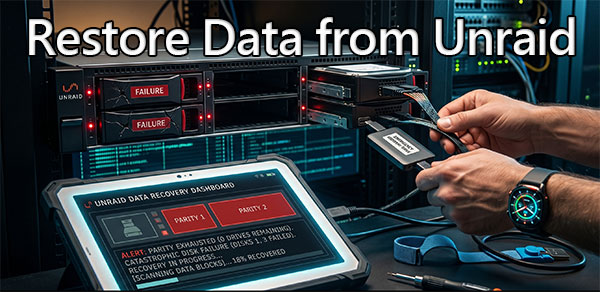
A single disk failure in an Unraid array is a predictable, manageable event — provided you respond to it correctly. The system keeps running, your data remains accessible, and there is a defined path to full recovery. None of this is accidental. It follows directly from how Unraid structures its arrays.

This article covers the mechanics behind that protection, the correct procedure for replacing a failed drive, and what to do when the standard path doesn't work and data needs to be extracted from the outside.

When someone contacts a data recovery specialist about a failed array, the answer to "which RAID level is it?" shapes everything that follows. RAIDZ1 and RAID 5 share the same fundamental idea — distribute parity across disks so any single drive can be lost without data loss — but they behave quite differently under stress. Those differences become very concrete once you're staring at a degraded array. This article focuses on what the architectural differences mean for failure probability, recovery difficulty, and which tools actually work in each case.

Online Chat with Recovery Software