The NAS TerraMaster F2-421 is widely used for secure storage, yet failures still occur — from disk degradation to RAID corruption and system-level errors. As a result, users may lose access to critical information. This article examines the common causes of data loss on the NAS TerraMaster F2-421 and provides a detailed overview of available recovery options.
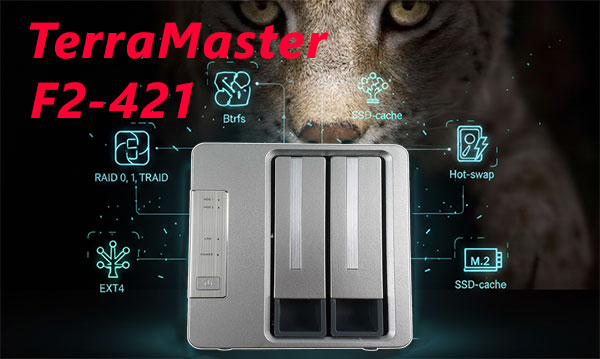
Core Technical Specifications of the NAS System
The TerraMaster F2-421 NAS includes 2 drive bays with RAID 0/1 support, allowing either performance boosting or mirrored data protection. It operates on EXT4 or Btrfs, offering stable file-system architecture with improved data consistency. Network connectivity is optimized for multi-device access and fast file operations.
Essential Tips for Successful Data Recovery on TerraMaster F2-421
Recovering data from the TerraMaster F2-421 becomes much easier when you understand how its two-bay structure and RAID configuration affect the recovery process. Since the device stores information in either RAID 0 (striping) or RAID 1 (mirroring), the restoration workflow depends on how the data was distributed across the drives.
The filesystem used — typically EXT4 or Btrfs — also influences what can be restored. For example, Btrfs snapshots help preserve structure, while EXT4 journaling may overwrite deleted entries.
Recommended steps:
- Create sector-by-sector images of both drives to avoid additional data loss.
- Identify RAID parameters (chunk size, order, layout).
- Use NAS-oriented recovery software capable of automatic RAID detection and reconstruction.
- Export recovered files to a separate external storage to avoid overwriting original media.
These simple principles significantly increase the success rate of data restoration on TerraMaster F2-421.
Main Features of the TerraMaster F2-421 NAS
| Drive Bays | Supported Drives | Hot Swappable | Supported RAID | File Systems | Maximum volume |
| 2 | 2.5" or 3.5" SATA | ✓ | RAID 0, RAID 1, JBOD, SINGLE | BTRFS, EXT4 | 36 Tb |
The unit is deployed as a mirrored setup centered on RAID 1, running the vendor firmware identified as TOS 4.x / 5.1 on a Celeron J3455 platform with 4GB of main memory. Supported on-disk formats listed for the device are BTRFS and EXT4, and the configuration explicitly has SSD cache: No. In this controlled environment the single most probable model-specific failure point is the on-box filesystem state as managed by TOS 4.x / 5.1 atop the RAID 1 mirror: when the filesystem implementation under TOS and the mirrored devices fall out of coherent state, the NAS can no longer present a consistent volume to clients.
Logical inaccessibility therefore stems from an inconsistency between the RAID 1 mirror and the filesystem instance for BTRFS or EXT4 under the running OS, preventing the device from exposing a recoverable logical volume. Given the platform constraints (Celeron J3455, 4GB) and absence of an SSD cache, on-device intervention risks further alteration of that state. The recovery principle is to remove the physical media, assemble the mirror on an external workstation that supports the specified filesystems, open the assembled volume read‑only to extract intact data and, if necessary, reconstruct the filesystem structures outside the NAS firmware environment.
Step-by-Step Guide to Recover Data from NAS TerraMaster F2-421
Recovering data from a two-bay NAS TerraMaster F2-421 is possible even after RAID corruption, disk failure, or file-system issues (EXT4/Btrfs). Follow this step-by-step procedure to safely restore your files:
-
Step 1 Power off the NAS and remove both drives.
Shut down the device completely and carefully extract the disks. Note their exact order — it is essential for RAID reconstruction.
-
Step 2 Connect the drives to your PC.
Use SATA ports or USB-to-SATA adapters. Both drives must be detected at the same time for correct RAID assembly.
-
Step 3 Launch the NAS recovery software.
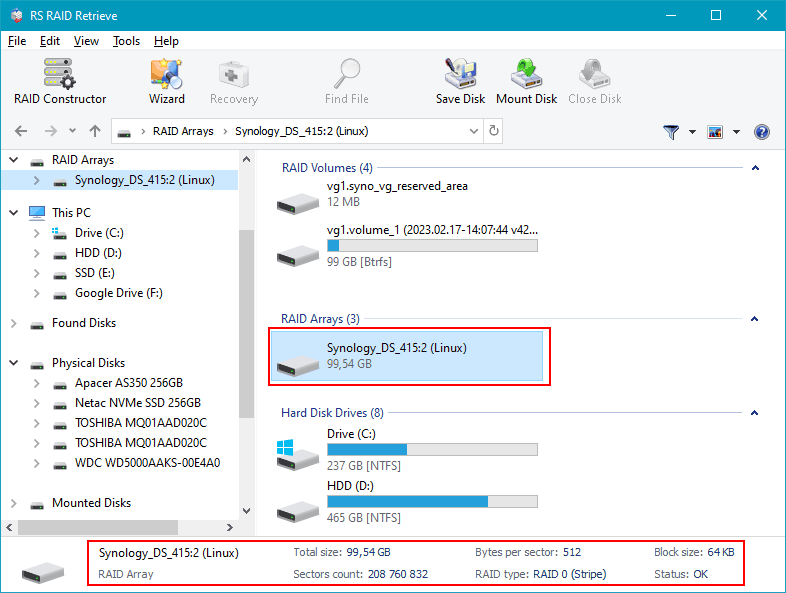
Open RS RAID Retrieve. The program will scan both disks and automatically detect the original RAID layout. Verify the parameters displayed at the bottom of the screen.

Data recovery from damaged RAID arrays
Available for: Windows, macOS, Linux -
Step 4 Confirm or adjust RAID configuration.
If automatic detection fails, manually set RAID 0 or RAID 1 parameters.
-
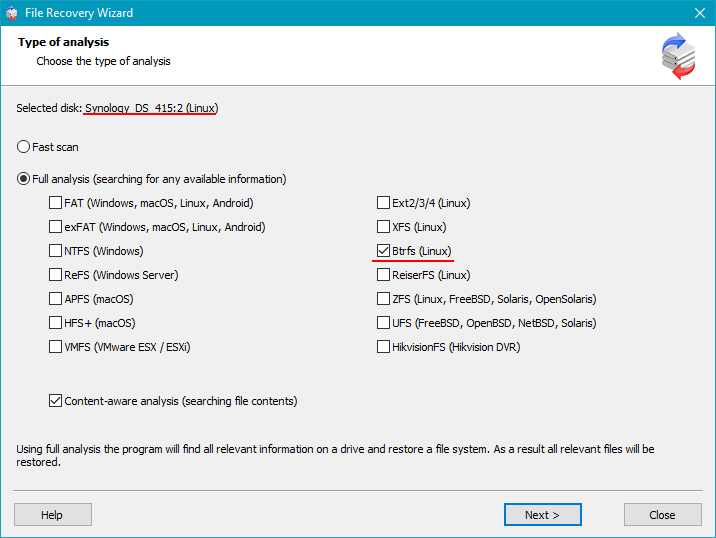
Step 5 Run a full scan.
The software rebuilds the file system structure and searches for deleted or corrupted files.
-
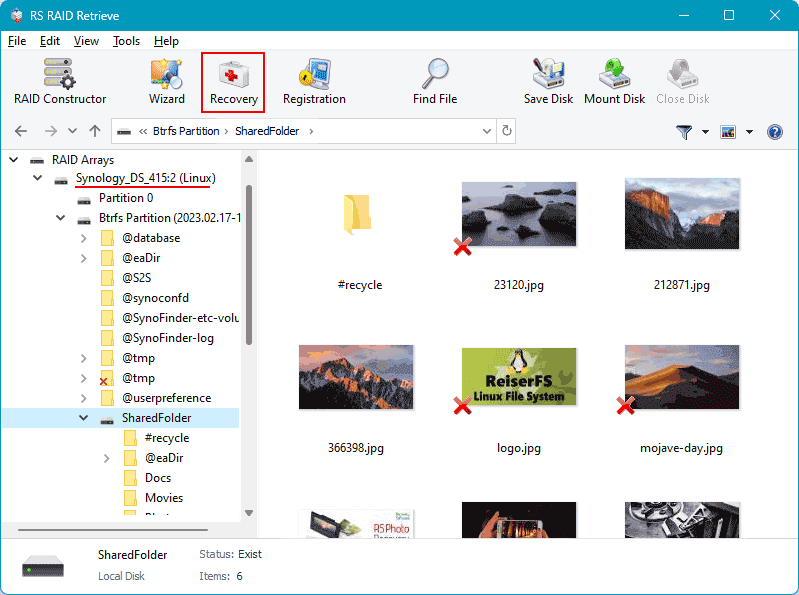
Step 6 Review the recovered folders.
Browse photos, videos, documents, and check integrity before exporting.
-
Step 7 Save your recovered data.
Select a different drive or partition to avoid overwriting original disks.
Tip: Never write new data to the original NAS drives during recovery.
The main causes of data loss in NAS devices
Disk failure. Physical malfunction of HDD or SSD is a common reason for data loss, especially in 2-disk NAS systems affecting RAID0 and important for RAID1.
Human errors (deletion, formatting). Accidental deletion or incorrect formatting can result in inaccessible files, requiring prompt recovery actions.
Firmware or DSM update errors. Improper system updates may corrupt partition tables or file metadata, causing data loss.
Power problems and sudden shutdowns. Unexpected power interruptions during write operations can damage file systems and compromise RAID integrity.
Technical causes and diagnostic steps for 2-disk NAS RAID failures
The failure of a RAID array in a 2-disk NAS TerraMaster F2-421 typically occurs due to several low-level processes breaking down simultaneously. RAID metadata corruption, disk desynchronization, sector-level degradation, and controller instability together contribute to the gradual or sudden loss of redundancy. Below is a structured technical breakdown of how RAID failure usually develops and why data recovery becomes necessary.
Step 1: Initial disk instability detected through SMART anomalies. Early RAID degradation is often reflected in rising reallocated sector counts, unstable read times, or intermittent I/O delays. Even if the NAS does not yet show an error, delays in block access can cause the RAID engine to fail parity or mirror synchronization.
Step 2: The NAS TerraMaster F2-421 controller marks one drive as “Abnormal.” When the controller repeatedly encounters unreadable sectors or timeout events, it isolates the disk. At this stage the drive may still appear “online,” but internal mechanisms already prevent accurate parity calculations.
Step 3: The drive becomes undetectable or is automatically removed from the array. Firmware lock-ups, voltage fluctuations, or head-positioning errors often cause the drive to disconnect completely. Once this happens, the RAID enters a degraded state where redundancy no longer exists.
Step 4: RAID metadata becomes inconsistent. With missing writes, corrupted parity blocks, or incomplete mirror updates, the RAID superblock may lose alignment. As a result, the NAS may fail to mount the array or show the volume as “Crashed.”
Step 5: File access issues escalate. Users typically begin noticing corrupted files, disappearing folders, or long delays opening large directories. In RAID 0 configurations, even a single disk failure leads to immediate data loss across the entire array.
- SMART degradation and growing sector instability
- Array desynchronization due to timeout errors
- Controller-level RAID metadata corruption
- Low-level file system damage on degraded volumes