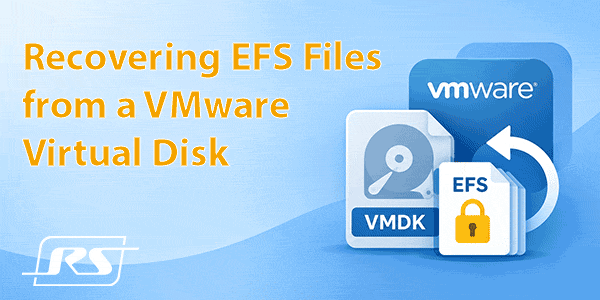
Recovering EFS Files from a VMware Virtual Disk
.efs-vmware-article .scenario-card h3{margin:0;font-size:15px;line-height:1.3} .efs-vmware-article .scenario-card.amber h3{color:#b7770d} .efs-vmware-article .scenario-card.red h3{color:#c0392b} .efs-vmware-article .scenario-card.dark h3{color:#5d6d7e} .efs-vmware-article p code{white-space:normal;overflow-wrap:anywhere} .efs-vmware-article pre code{white-space:pre;font-size:13px}

The VM is gone — deleted, corrupted, or replaced — but the .vmdk file survived, maybe with a snapshot or two attached. Somewhere on that disk are EFS-encrypted files, and mounting the disk doesn't make them readable. This covers recovering files from a VMware virtual disk with RS Partition Recovery, and why finding the right certificate matters more than the recovery step itself.
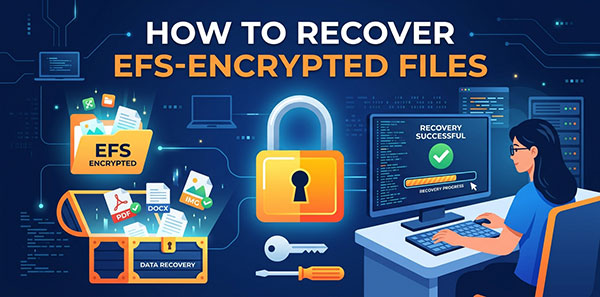
Recovering EFS-Encrypted Files: Causes, Certificates, and Practical Recovery

You encrypted a folder with EFS, then something happened — a reinstall, a profile reset, an accidental deletion, a drive moved to another PC. Now the files are back, but every one throws Access Denied. The data itself is not damaged; the private key that unlocks it is simply missing. This guide covers why that happens and how to recover and decrypt EFS-encrypted files with RS Partition Recovery.

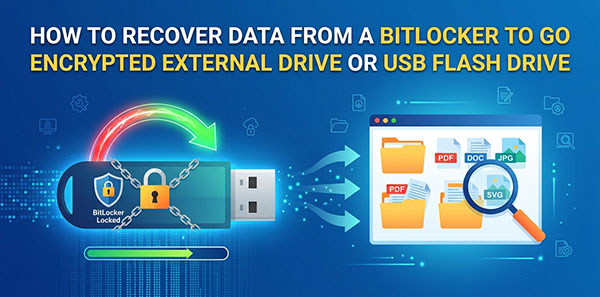
Recover Data from a BitLocker To Go Encrypted Drive

BitLocker To Go is the same encryption engine as system-drive BitLocker, applied to removable media — external HDDs, SSDs, and USB flash drives. The unlock mechanics carry over from our guide to recovering an internal BitLocker volume, but removable drives fail differently in practice: no TPM to fall back on, a visible FAT32 partition that gets mistaken for the whole drive, and a higher rate of physical disconnects mid-operation. This guide covers what's specific to external and USB drives.

How to Recover Data from a BitLocker-Encrypted Drive

Recovering data from a BitLocker-encrypted drive isn't the same problem in every case. A forgotten password with the recovery key still in hand is a five-minute fix. A corrupted partition table on an encrypted volume, or a system drive that lost its TPM binding after a hardware change, is a different situation entirely — the volume is still there, but locating and unlocking it takes more than typing a password into Windows. This guide covers both, for the system volume (C) and any additional encrypted data volume (D).

Synology SHR1 Data Recovery After Two Drives Failed

Two drives have failed in your Synology SHR-1 array. DSM reports the storage pool as Crashed and states that data cannot be recovered. SHR-1 data recovery after a double drive failure is the subject of this article — and the situation is more nuanced than DSM's message suggests. Whether your data is recoverable depends not on the count of failed drives alone, but on how they failed and what state the surviving drives are in.