

Deleted File Recovery Software
Recover deleted documents, photos, videos and other files from hard drives, USB drives and memory cards. Find your files, preview them and save what you need.
When Can You Use RS File Recovery?
Recover deleted files or access supported file systems on a single disk, whether the storage came from your computer, a removable device, a NAS or a server.
Accidentally or Permanently Deleted Files
Recover documents, photos, folders and other files deleted by mistake, removed with Shift+Delete, or cleared from the Recycle Bin or Trash. Scan the drive where the files were stored and preview the results.
Files Deleted from Removable Storage
Find deleted files on USB flash drives, external HDDs and SSDs, SD and microSD cards, and other memory cards. Select the device or partition where the files were stored and scan it.
Files Deleted by Applications or Antivirus Software
Search for files removed by an application, cleanup utility or antivirus software. If the original files have not been overwritten, the scan may locate them for recovery.
Original Files Deleted by Malware or Ransomware
Search the drive for original files deleted during a malware or ransomware attack. Recovery depends on whether the original data remains available; the program does not decrypt files encrypted by ransomware.
Access File Systems Your OS Cannot Read
Open supported file systems from Windows, macOS or Linux even when the operating system does not normally recognize them. Browse available files and recover deleted items from the connected storage.
Access Single-Disk NAS and Server Storage
Work with a disk removed from a single-drive NAS, Linux server or another system with nested storage. The program can recognize supported layers, including controller-created single-disk volumes, LVM, thick and thin pools, snapshots and file systems, when the required storage structure is contained on one physical disk.
Recover Deleted Files with RS File Recovery
Find accidentally deleted files and select the ones you need with a guided recovery wizard and an Explorer-like interface.
Recover Deleted Files
Find files removed from a drive, deleted with Shift+Delete or cleared from the Recycle Bin. Browse scan results in an Explorer-like interface and select the files you need.
Find the Files You Need
Use search filters to narrow the results by file type, date or size. Browse the files found on the selected drive and choose what to recover.
Find Files by Their Contents
Deep scan searches the drive for known file signatures, helping locate supported file types even when their file system records are unavailable. Files found this way may no longer have their original names or folder paths.
Preview Files Before Recovery
Open previews of supported images and documents in the scan results to check their contents before deciding which files to recover.
Guided Recovery Wizard
The step-by-step wizard helps you choose a disk, select scan and search options, review found files and choose a recovery destination.
Work with a Virtual Drive Image
Create a bit-precise image of a disk or removable device and scan the image instead of repeatedly working with the original media. This can be useful in more difficult recovery cases.
Fast Scan and Content-Aware File Recovery
Analyze a selected partition or an entire physical disk, using file system metadata and, when needed, the signatures of supported file types.
Fast Scan for Deleted Files
Start with Fast Scan after accidental deletion, Shift+Delete, emptying the Recycle Bin or Trash, or another permanent deletion. It reads current file system metadata to locate existing and deleted files and folders. Browse the results and look for the files in their original folders when that information is available.
Recover Names, Folders and Fragments
When the file system retains complete allocation information, the program can restore a file's original name, folder path and timestamps. It can also use the recorded locations of its fragments to reconstruct a fragmented file.
Content-Aware Analysis
When sufficient file system records are no longer available, content-aware analysis searches for supported formats by their internal signatures. This can find files without relying on their original file system entries. This provides another way to look for supported files when the original directory information is missing.
Understand the Results
Files found only by signature may lose their names, folder paths, timestamps and other metadata. Without records of fragment locations and order, a fragmented file may be recovered only partially or may be damaged. Preview supported files to check the results.
Tools for a More Convenient Recovery
Check your drive, save scan results and inspect data while you work through the recovery process.
S.M.A.R.T. Drive Health
Check available S.M.A.R.T. information to assess the condition of a supported drive before recovery. Health indicators can help you identify a drive that needs attention. If the drive is unstable, a disk image can provide a separate copy to work with during analysis.
Save and Resume Analysis
Save the analysis results and return to them later. Continue browsing and recovering files without scanning the storage again. This is useful when you need more time to review a large set of results or recover files in several sessions.
HEX Editor for Data Inspection
Inspect data in hexadecimal form with the built-in HEX Editor. The tool is intended for viewing data; it does not provide editing.
Preview Deleted Files Before You Recover Them
Browse scan results and preview supported documents and images to find the files you need. The free trial lets you scan and preview; a license is required to save recovered files.
Recover Documents, Photos, Videos and More
RS File Recovery supports a wide range of file formats, including common office, image, audio, video, archive and database files.
Documents
Word, Excel, PowerPoint, PDF and RTF files
Photos and Images
JPEG, BMP, PSD, CR2, CRW and other image formats
Audio and Video
MP3, WAV, AVI, MKV, MOV, MPEG and more
Archives
ZIP and other compressed files
Email and Databases
Outlook PST, DBF, MDB and other database files
Folders
Recover files and folders from supported file systems
Recover Files from Hard Drives, USB Drives and Memory Cards
Scan fixed and removable storage, or create a virtual drive image and work with the image file.
Desktop and laptop HDDs
Solid-state drives
USB sticks and external flash storage
SD, SDHC, SDXC, CompactFlash, Memory Stick, xD and MMC
Supported cameras and media players connected over USB
Disk images created for recovery work
Supported File Systems
Recover deleted files from drives using supported Windows, macOS, Linux and Unix file systems.
How to Recover Files with RS File Recovery
Use the wizard to scan the source, review the results and save recoverable files to a safe destination.
Select the Drive
Choose the disk, partition, removable device or virtual drive image containing the lost files. If you know where the files were stored, start with that location.
Choose Scan Options
Start with Fast Scan for deleted files. Select scan and filter options suited to your search.
Review the Results
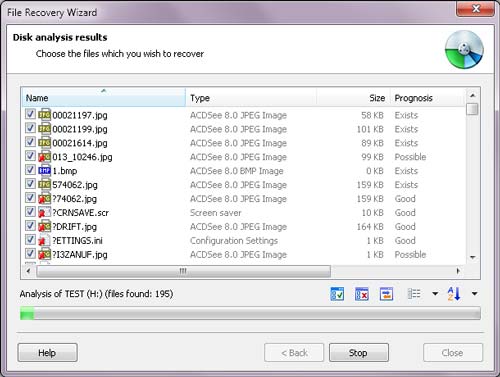
Browse found files, narrow the results with filters and preview supported documents or images. Check their contents before deciding which files to save.
Save to Another Location
Save recovered files to a different disk, an FTP location or CD/DVD. Do not save them back to the source drive.
Find and Preview Your Lost Files
Scan your drive and preview supported files for free. Purchase a license when you are ready to save them.
File Recovery Guides
Step-by-step help for recovering deleted files from common storage devices.
Recover Deleted Files from a USB Flash Drive
Learn how to scan a USB drive and restore files deleted from it.
Read the guideRecover Files Deleted with Shift+Delete
What to do when files were deleted without going to the Recycle Bin.
Read the guideRecover Files After Emptying the Recycle Bin
Learn how to find files removed from the Recycle Bin.
Read the guideOther Data Recovery Software
RS Partition Recovery
Recover data from formatted, damaged or inaccessible drives and lost partitions.
Find out moreRS Photo Recovery
Recover deleted photos and images from memory cards, USB drives and disks.
Find out moreRS Browser Forensics
Analyze available browser history, bookmarks and saved account information.
Find out moreFrequently Asked Questions
Yes, you can.
One of the reasons may be damage to the file structure of the flash drive.
RS Photo Recovery can recover photos from a damaged memory card.
- Connect the memory card to the computer. The card must be determined.
- Launch RS Photo Recovery and start analysis.
One of the reasons may be corruption of data containing information about the photos.
- Use content-aware analysis to find deleted images by content.
- Use RS File Repair to repair damaged photos based on residual information.
Yes, it is possible. RS Photo Recovery can recover photos from a damaged memory card.
- Connect the memory stick to your computer. The card must be detected.
- Launch RS Photo Recovery software and start the analysis.
Yes, it is possible to recover deleted files if they have not been overwritten by new data.
Stop using the disk (create an image) as soon as the files have been deleted and use the professional data recovery software RS File Recovery to recover the deleted files.
RS File Recovery is shareware. The free version of the program, all functions are available for use, except to save the data.
This greatly depends on the capacity of your hard drive and your computer's performance. Basically, most of hard disk recovery operations can be performed in about 3-12 hours HDD 1TB in normal conditions.
If the file does not open, it means that the file was damaged or corrupted before recovery.
Use "Preview" to evaluate the quality of the recovered file.
When you try to access the drive, you get the message "Drive is not accessible" or "You need to format the partition drive"
Your disk structure is corrupted.
In most cases, the data may still remain available. Just run the data recovery software and scan the desired partition to get it back.
